From March 22 to 31, 2025, the Utah desert stood in for Mars. Carolus Vitalis spent those days at the Mars Desert Research Station near Hanksville, on a crew that ran simulated surface missions twice a day and, on the final one, took his turn in command.
“If we are going to send biology to Mars, it has to be designed for Mars. I went to see what it will be up against.”
He is a biomedical engineer and synthetic biologist, not an aerospace one. He went to the station to learn the demands of crewed exploration first-hand, so that his work in genetic engineering could be pointed at the problems such missions will face.
The rotation ran through ASEN 5226, a University of Colorado Boulder course in medicine in space and surface environments; the crew wore its initials, MISSE, on the suit. Its members came from several fields, aerospace and mechanical engineering, medicine, and the Air Force, with Vitalis the biomedical engineer among them, and were split into teams of four to seven whose roles changed from one simulation to the next. Across the week they carried out suited extravehicular activities, drove rovers, ran emergency triage, and planned missions.
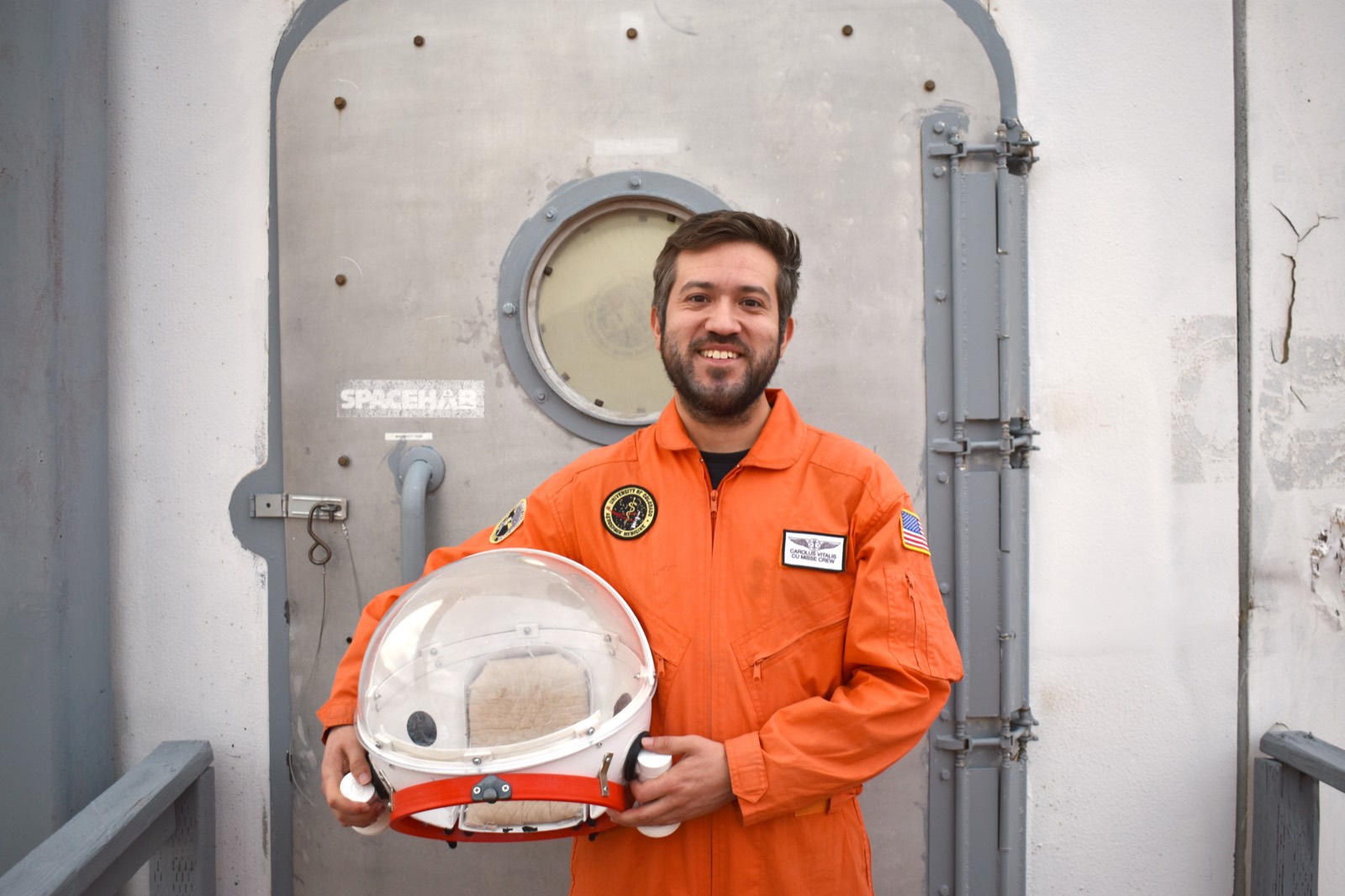
The last mission was his to command, and its two demands sat closest to his own field. The crew set out to look for signs of life, a biological question before an engineering one, and the exercise turned, by design, into a medical emergency: a crew member needed help far from the habitat, and the team had to deliver it. On a crew of aerospace and mechanical engineers and Air Force officers, the search and the triage were Vitalis’s terrain as a biologist and biomedical engineer, and he directed the logistics and the people while the clock ran.
He came back to the laboratory with those constraints in view, and a clearer sense of the biology such missions will one day need.